
Airplanes: A Karmic Photo Essay
Three 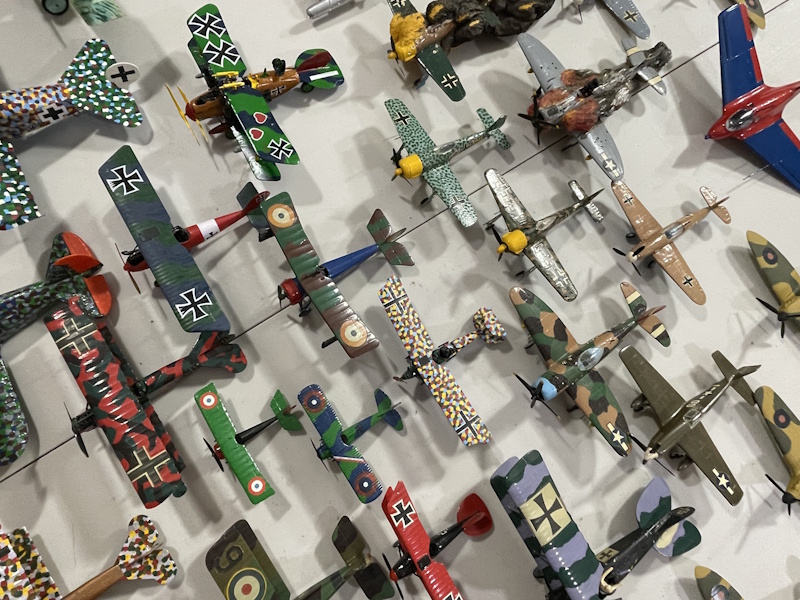 attic boxes disgorged model airplanes dating from as long ago as 1967. I think I’ve built around eighty or ninety since then, most in the sixties and early seventies, but I occasionally still do a few. Forty-eight still exist. The models obviously don’t approach the level of art, but they do represent 3D homages to beautiful flying objects, and several connect to my fiction.
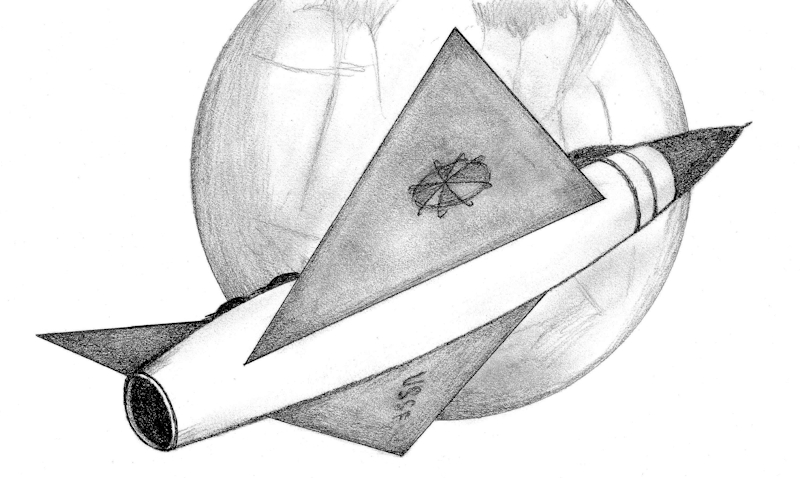
This year saw an urge to build several more planes as well as to investigate the ancient ones I’ve retained all these decades. First, I purchased an old 1978 edition of an F-102 model airplane kit to renew, I think, my subconscious inspiration for my Jack Commer series’ Typhoon I spaceship, seen in Trip to Mars.

The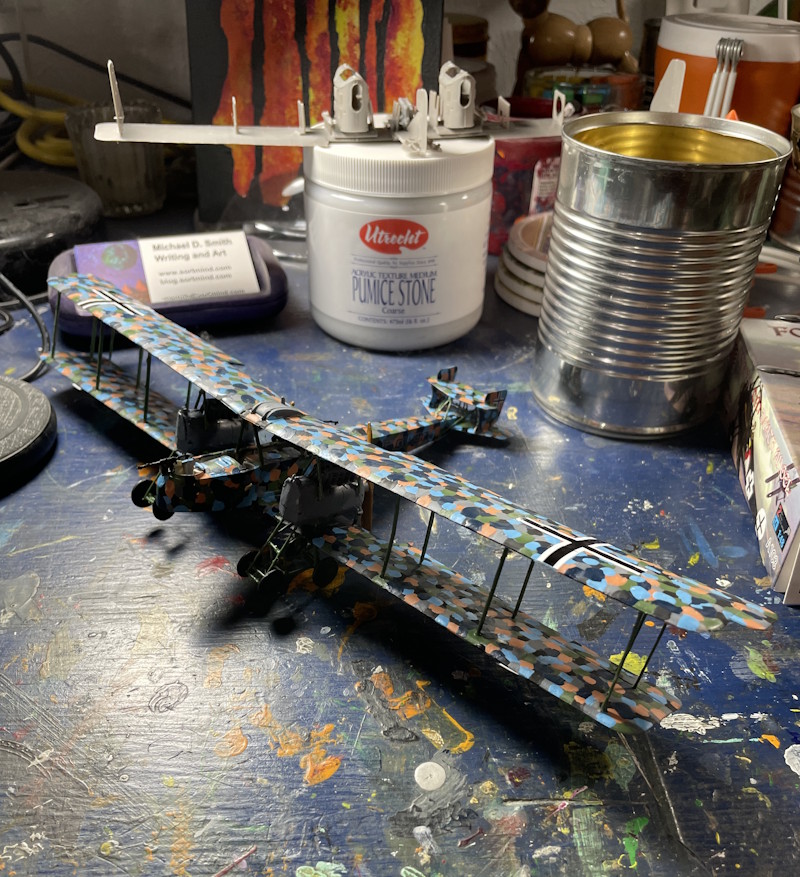 n I spent a week putting together the astoundingly complex German W.W.I Gotha G.Vb long-range bomber, which was akin to building a ship in a bottle; I’m surprised the producers of the kit didn’t have me installing 1/72 scale spark plugs in the engine. I still boggle at the idea of being one of the three crew aboard this contraption somewhere over the English channel, at night, summer 1918.
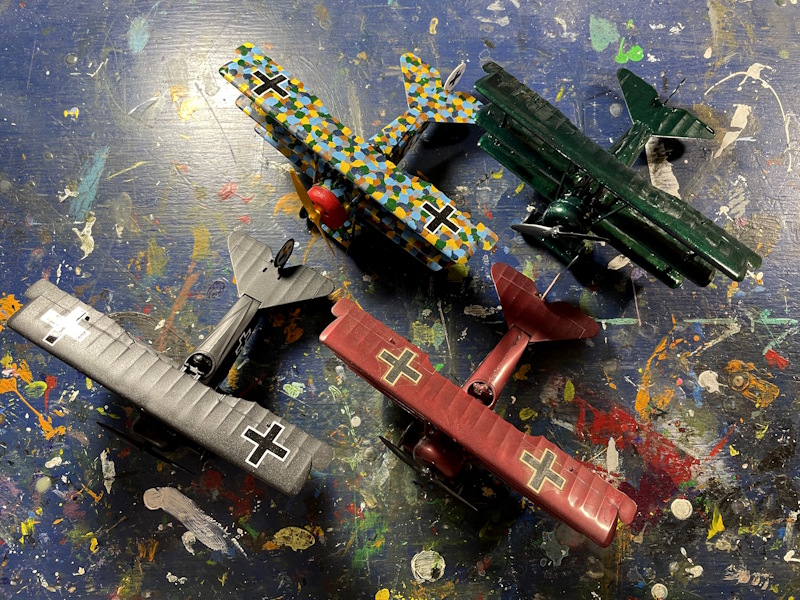
Next I got a 1/48 scale Fokker Triplane and built it as an homage to my first 1967 triplane, translucent crimson and unpainted. Somehow that led to buying two more triplanes, painting one in camouflage and one in a dark green like the one my father built for me in the fifties.
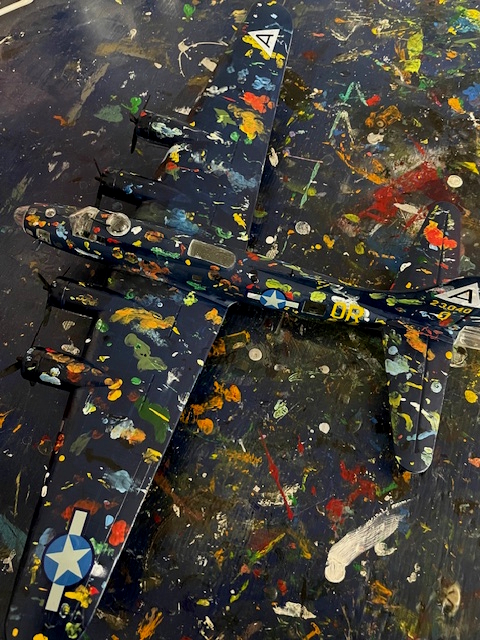 Then the B-17 dredged up awe at my father flying this bomber in World War II, as well as memories of the couple times I’ve walked through a real B-17. Matching its colors to my paint-spattered art table was challenging, and I decided that, commercial model or not, this well-camouflaged ship is now a mini-sculpture; it definitely supersedes the model airplane concept.
This led to dealing with two other models that had been sitting in boxes for years.
One was a 1971 edition of the Boeing F4B-4 carrier biplane from the 1930s, which I’d bought to represent the Mystery Yellow Biplane of E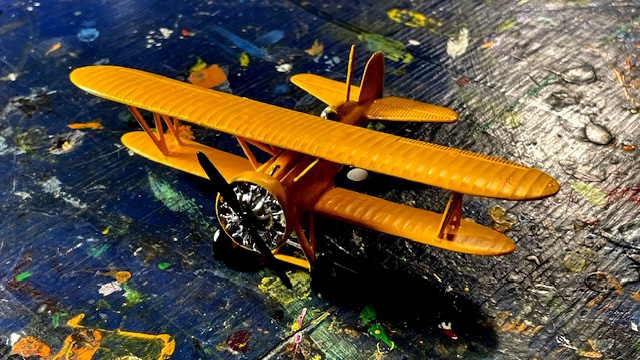 vil from Asylum and Mirage, in which frightened young urbanites cannot bring themselves to admit they’re hallucinating yellow biplanes–which are in fact real. Thus no 1930s decals on the mystery biplane.
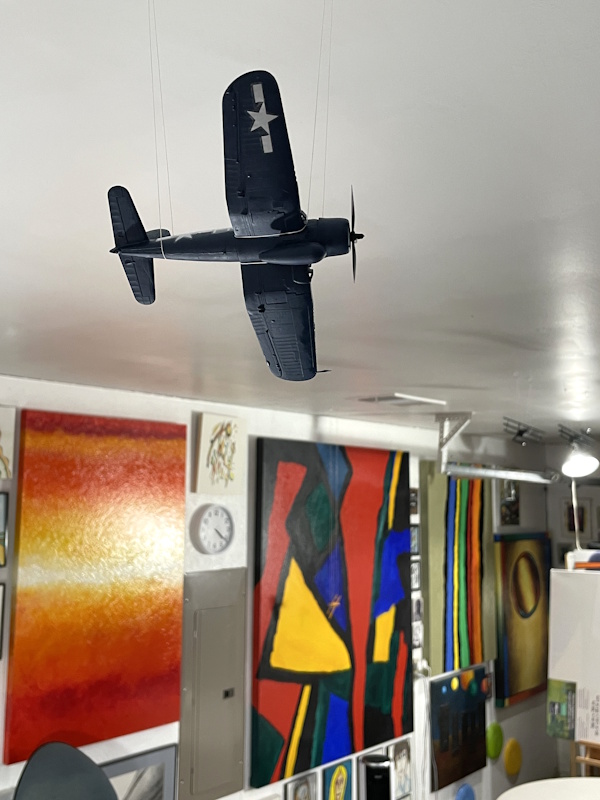 Then I finally built the F4U-1 Corsair carrier plane, a glorious shape and a 2017 birthday present from a friend.
In addition to doing minor repair on fragile plastic airplanes crammed into boxes, I wanted to restore two items.
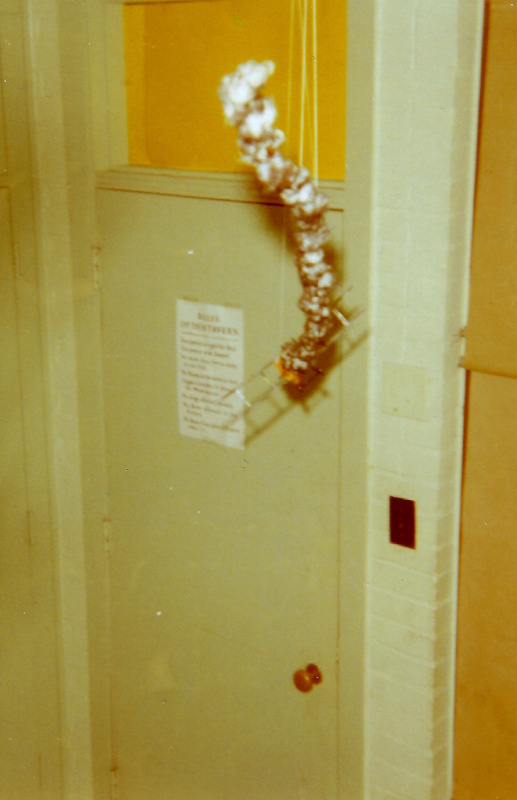
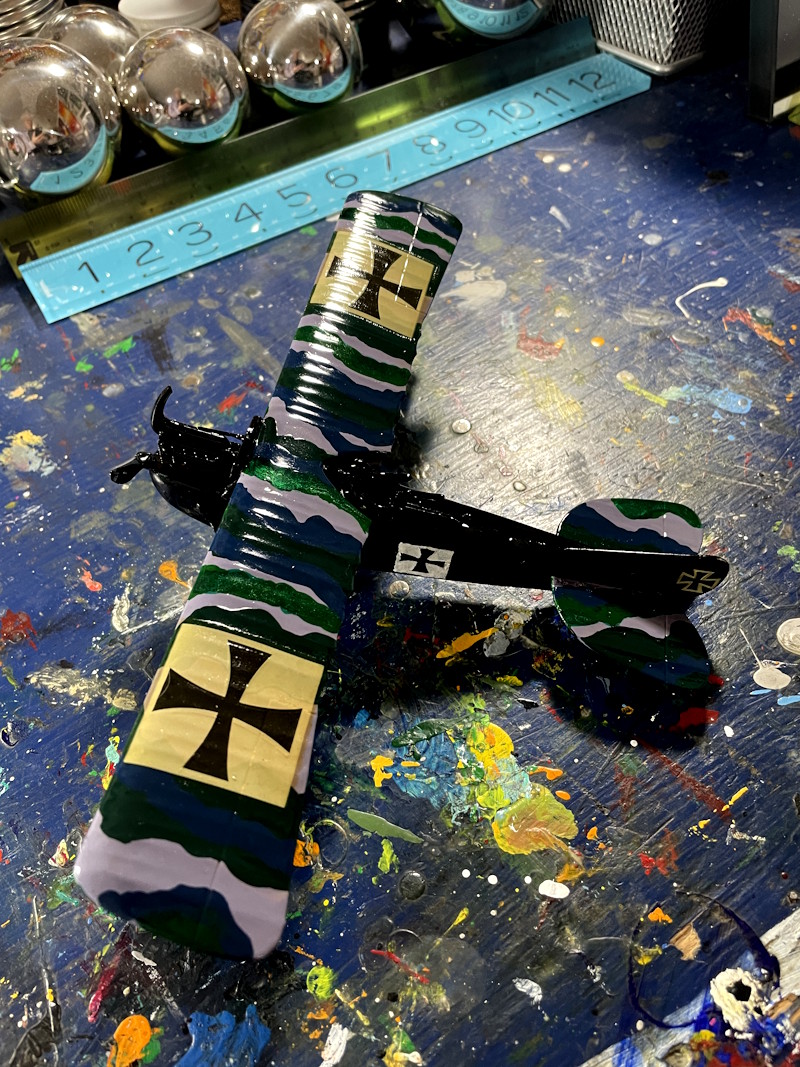 First was the German Albatros D.III, which somehow survived having a six-foot coat hanger-and-cotton ball flame glued to it as it was shot down by a Sopwith Triplane in my dorm room my first month at Rice. The plane remained basically intact for fifty-five years and just needed new paint and a snazzy gloss overcoat.
 The other model brought up my 1979-80 fascination with the German W.W.II Me-163B rocket fighter, and the first version of The University of Mars which featured it. Yet I discarded any Me-163 models I built then, the same the way I’d trashed eleven or twelve Me-262 jet fighters from the seventies. I think rereading The Rise and Fall of the Third Reich brought home the fact that these swastika-tailed devices were murder machines in service of a totalitarian empire, and I decided I wanted nothing further to do with them–though I did discover in the attic boxes three FW-190s and 2 Me-109s from my sixties era; one FW-190 was an early experiment in cotton ball flames.
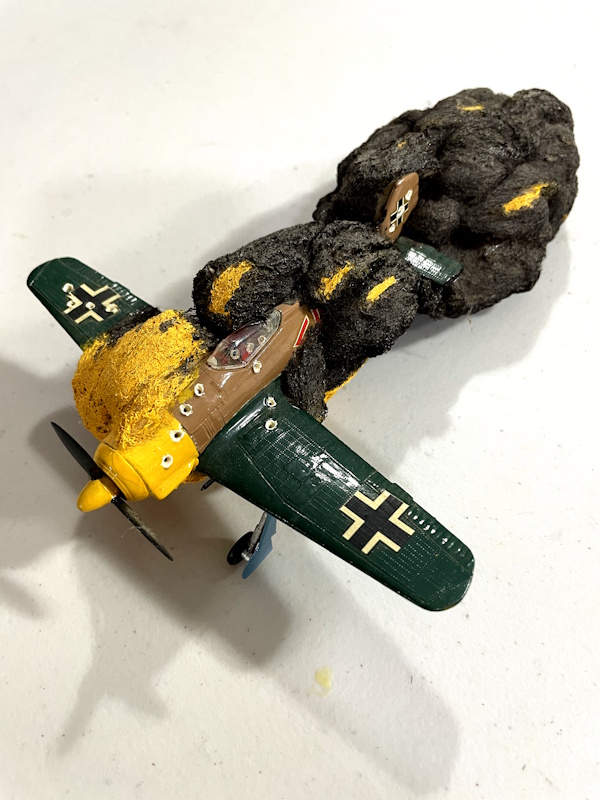

In any case, cut to this 1/48 scale Me-163 I built in the late eighties; I preserved its aesthetic shape by painting it in glossy non-regulation colors with no decals, I guess so I could think of it as a lovely object somehow divorced from Nazi Germany. Maybe that was fine at the time, but when I opened the attic boxes and saw this thing, I was disgusted with the cover-up it implied.
So 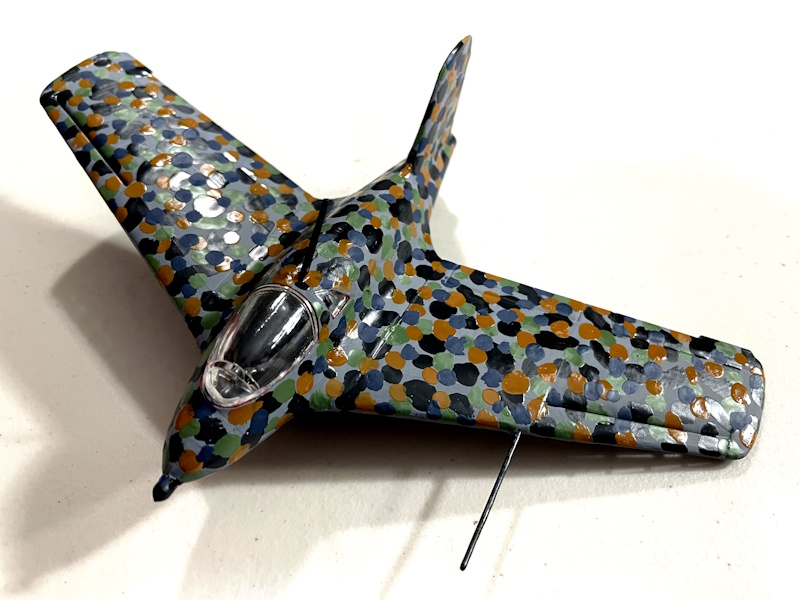 I painted it flat gray with a reasonable approximation of camouflage. I’ve ordered decals for it, and will at least acknowledge the ghastly mixture of technological genius and collapsing empire this machine represents.
copyright 2025 by Michael D. Smith
More background:
Comments
Airplanes: A Karmic Photo Essay — No Comments
HTML tags allowed in your comment: <a href="" title=""> <abbr title=""> <acronym title=""> <b> <blockquote cite=""> <cite> <code> <del datetime=""> <em> <i> <q cite=""> <s> <strike> <strong>